Machine learning for adaptive optics in microscopy
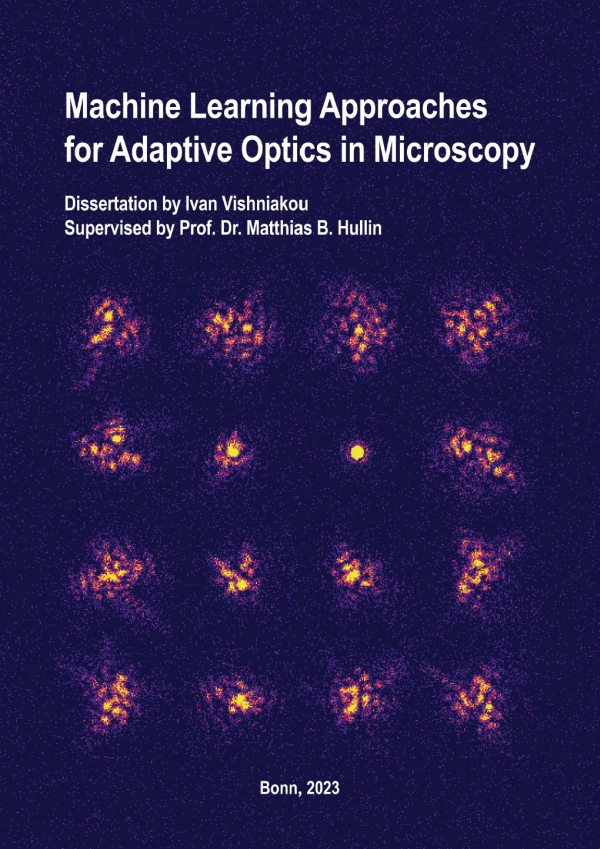
Adaptive optics (AO) – was my main focus at the Max Planck Institute of Neurobiology of Behavior and the topic of my PhD dissertation.
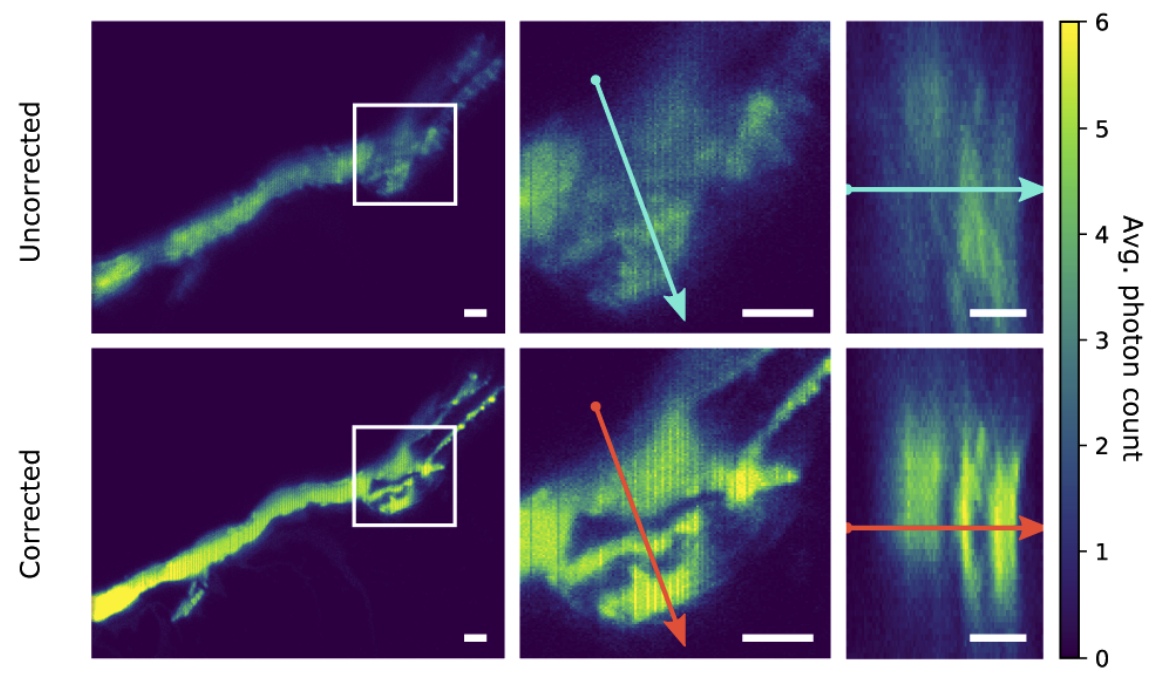
 Imaging in fluorescent microscopy relies on focusing light inside the sample with the objective. However when encountering tissue in biological samples, light gets scattered and deflected off its path resulting in broader and dimmer (aberrated) focus, not suitable for imaging. Adaptive optics is a technique of compensating sample aberration such that sharp focus is restored allowing imaging despite the aberration of the sample.
The main problem, however is discovering the correction needed for a particular imaging site. This can be regarded as an inverse problem of finding an aberration from its resulting effect on the images. In my thesis I have explored two diefferent approaches to this problem.
Machine learning approach - correction is predicted by a trained newural network:
-
Ivan Vishniakou, Johannes D. Seelig “Wavefront correction for adaptive optics with reflected light and deep neural networks”, Optics Express, 2020
-
Alex Turpin*, Ivan Vishniakou*, Johannes D. Seelig “Light scattering control in transmission and reflection with neural networks”, Optics express, 2018, *equal contribution
Differentiable optics approach - correction is found by optimization of the microscope model:
-
Ivan Vishniakou, Johannes D. Seelig “Differentiable optimization of the Debye-Wolf integral for light shaping and adaptive optics in two-photon microscopy”, Optics Express, 2023
-
Ivan Vishniakou, Johannes D. Seelig “Differentiable model-based adaptive optics for two-photon microscopy”, Optics Express, 2021
-
Ivan Vishniakou, Johannes D. Seelig “Differentiable model-based adaptive optics with transmitted and reflected light”, Optics Express, 2020